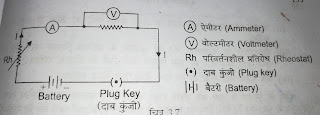
EXPERIMENTAL VERIFICATION OF OHM'S LAW OBJECTIVE:- Verification of ohm's law EQUIPMENT REQUIRED :- A battery, an ammeter, voltmeter, rheostat, plug key, coil, of unknown substance, connecting wire etc. THEORY :- Ohm's law deal with the relationship between voltage (p.d) and current in an ideal conductor. This relationship states that - The p. d.(voltage) across an ideal conductor is directly proportional the current through it. Ohm's law given by V=IR Where, V= potential difference I= current R= constant (Resistance) CIRCUIT DIAGRAM :- PROCEDURE:- 1. The circuit is connected as per the circuit diagram. 2. The plug key is inserted and the rheostat is adjusted so that a definite amount of current (I) flows in the circuit. This value of current is recorded. 3. As the current flows through the unknown resistance a p. d. is developed which is read from voltmeter. 4. The procedure is again adjusted to a different v...
Type of chemical reactions 1.) Combination Reaction :- When two or more substances (elements or compounds) combine to form a single product. Whose properties are entirely different from the original substance. Ex - A + B -> C i. When coal burns in presence of air it produce carbon dioxide gas . C (g) + O2(g) -> CO2 (g) ii. When hydrogen combines with oxygen it forms water. H2 (g) + O2(g) -> H2O(l) Note :- In this reaction heat is produced. ➡️Exothermic reactions :- The reactions, in which heat is generated in course of formation of product, are Exothermic reaction. Ex- a.) CH4 (g) + 2O2(g) -> CO2 (g) +2H2O (g) + energy 2) Decomposition Reactions :- In this reaction, a substance is broken down into two or more new substances whose properties are different from the original s...

Comments
Post a Comment